ChatGPT vs Claude vs Perplexity: Best AI Chatbot for Content Creators (2026)
If you create content for a living, the ChatGPT vs Claude vs Perplexity debate matters more than benchmarks and model names suggest. Each tool approaches content work from a different angle, and the right choice depends on whether your biggest bottleneck is research, writing quality, or production speed. This guide breaks down how all three perform for real content workflows in 2026, what each one costs, and which combination makes the most sense for different types of creators.
ChatGPT vs Claude vs Perplexity: What Each Tool Actually Does
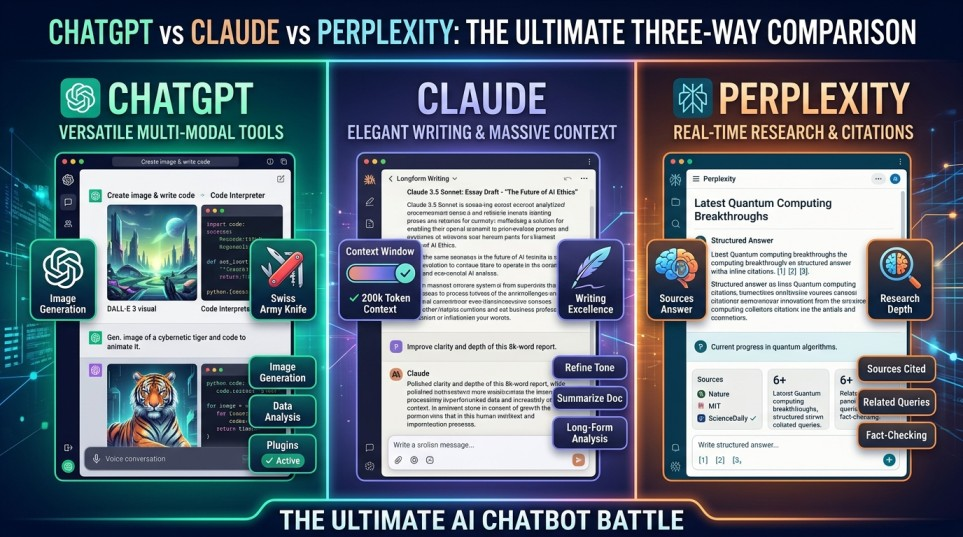
All three tools are AI chatbots, but they approach the job from fundamentally different angles. Understanding those angles is the fastest way to figure out which one fits your workflow.
ChatGPT: The Swiss Army Knife
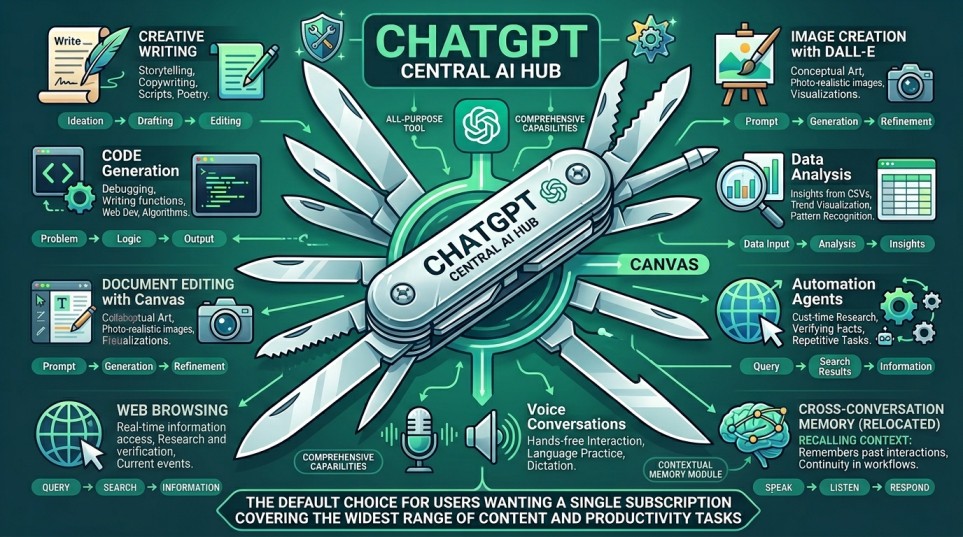
OpenAI’s ChatGPT remains the most widely adopted AI assistant on the market. The current flagship model, GPT-5.4 (launched March 5, 2026), powers the Plus and Pro tiers with strong performance across creative writing, code generation, image creation, and conversational tasks. The Canvas feature lets you edit and iterate on documents directly inside the chat interface, which is genuinely useful for content workflows that involve multiple revision passes.
ChatGPT’s biggest advantage for content creators is breadth. You can brainstorm headlines, draft social media posts, generate blog outlines, create images with DALL-E, write code snippets for your website, and handle basic research queries without switching tools. Its memory feature carries context across conversations, so it learns your preferences over time. The addition of Codex, Agent Mode, and Deep Research on Plus plans has expanded its capabilities well beyond basic chat.
The trade-off: ChatGPT’s writing can lean generic if you don’t prompt it carefully. It has a tendency to produce confident-sounding statements without citing sources, which means you still need to verify facts independently. And since February 2026, the Free and Go tiers display ads in the US, which changes the experience for non-paying users.
Claude: The Long-Form Writing Partner
Anthropic’s Claude has earned a reputation among professional writers for producing cleaner, more natural prose. The latest models, Claude Opus 4.6 and Claude Sonnet 4.6 (released in early 2026), handle nuanced writing tasks with a level of care that ChatGPT often misses. Where ChatGPT might give you a serviceable first draft, Claude tends to produce text that needs fewer edits before it sounds like a human wrote it.
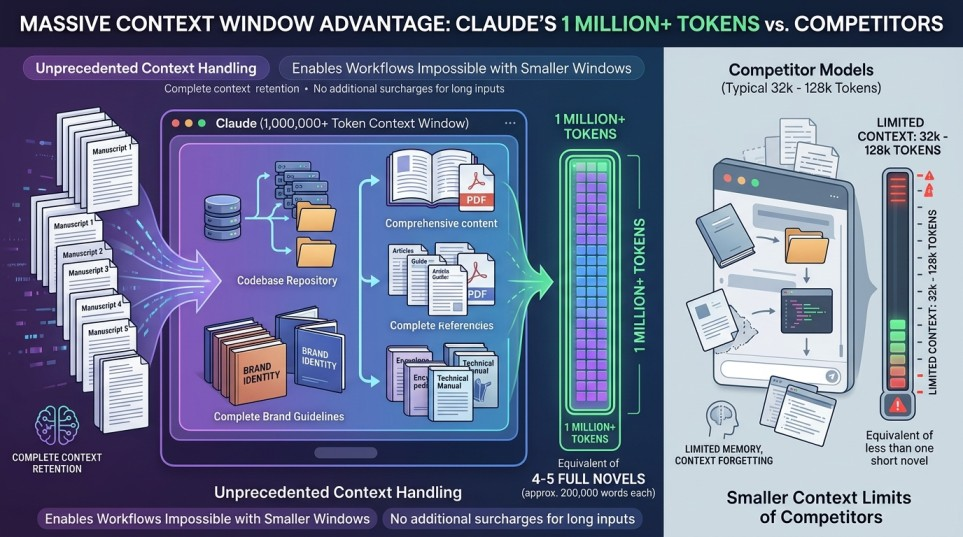
Claude’s standout feature is its 1 million token context window, which became generally available on March 13, 2026 at no extra charge. To put that in perspective, 1 million tokens is roughly 750,000 words — equivalent to about four or five full-length novels. You can paste an entire book-length manuscript, a complete content strategy document, or months of blog posts into a single conversation and get coherent analysis back. Previous Claude models topped out at 200,000 tokens, so this is a 5x increase that fundamentally changes what’s possible in a single session.
Claude also includes Claude Code (a terminal-based coding agent for developers), Cowork (an autonomous file and workflow assistant via the desktop app), and a Research feature on Pro plans that provides deeper topic exploration than standard chat responses.
The limitation: Claude’s web search capabilities exist but are not as deeply integrated as Perplexity’s citation-first approach. For content that requires up-to-the-minute facts and source verification, you’ll want to supplement Claude with a dedicated research tool. Claude also lacks built-in image generation.
Perplexity: The Research-First AI
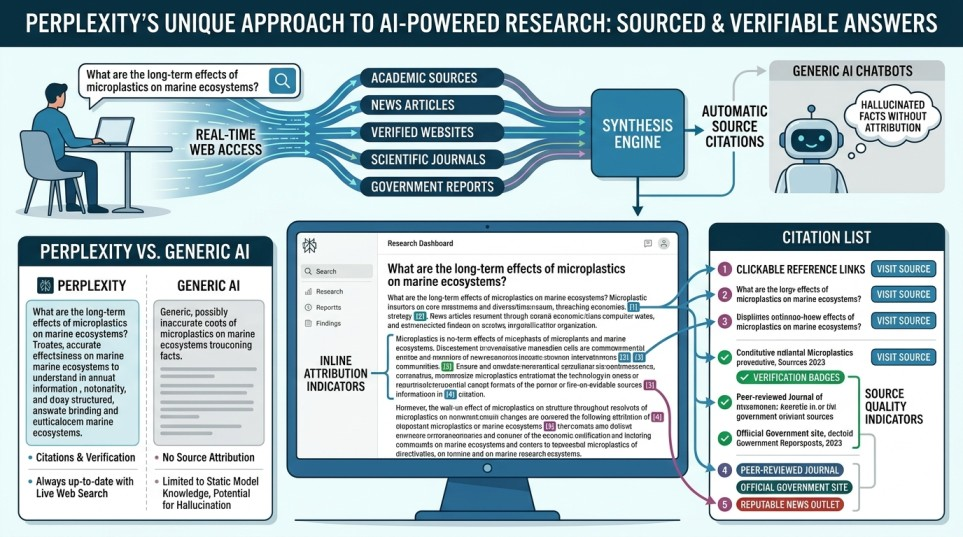
Perplexity takes a fundamentally different approach. Instead of generating text from its training data alone, every response is grounded in real-time web searches with inline source citations. You ask a question, and Perplexity shows you exactly where the information came from, with clickable links to verify every claim.
For content creators, this changes the research phase entirely. Instead of opening a dozen browser tabs, scanning articles, and manually pulling facts together, Perplexity synthesizes information from multiple sources into a coherent, cited answer. Its Deep Research feature goes further: it conducts a thorough multi-step investigation and produces a comprehensive report with full citations.
Perplexity Pro also gives you access to multiple AI models, including the latest versions from OpenAI, Anthropic, Google, and Perplexity’s own Sonar model. You can compare responses across engines without maintaining separate subscriptions to each.
The limitation: Perplexity is weaker at creative writing and iterative content development. It excels at finding and synthesizing information, not at crafting engaging blog intros or punchy social media copy. It also has limited conversational memory between sessions.
Head-to-Head: Where Each Tool Wins for Content Creators
Blog Post Drafting
Winner: Claude. Claude’s prose reads more naturally and requires fewer rounds of editing. It handles tone, structure, and nuance better than ChatGPT in most long-form scenarios, and its 1M token context window means you can feed it your entire content library as reference material in a single prompt. ChatGPT is a close second, especially with Canvas for iterative drafting. Perplexity is not designed for this task.
Research and Fact-Checking
Winner: Perplexity, and it’s not close. Perplexity’s automatic source citations, real-time web access, and Deep Research feature make it the clear choice for any content that requires accurate, current information. ChatGPT and Claude both have web search capabilities, but neither treats citation as a core feature the way Perplexity does. For anything where getting facts wrong has consequences, Perplexity is the tool.
Social Media Content
Winner: ChatGPT. ChatGPT’s speed, versatility, and ability to generate images alongside text make it the best choice for social media workflows. Need a LinkedIn carousel outline, five tweet variations, and a supporting image? ChatGPT handles all of that in one conversation. Claude writes better individual posts, but ChatGPT’s breadth wins for volume social work.
SEO Content Strategy
Winner: Perplexity + Claude (combination). Use Perplexity to research keyword opportunities, analyze competitor content, and pull current data with verified sources. Then switch to Claude to write the actual article with natural language that doesn’t read like it was optimized by a robot. This two-tool workflow produces better results than either tool alone.
Email Newsletters
Winner: Claude. Newsletters demand a conversational, personal tone. Claude handles this well because it avoids the “corporate AI” voice that ChatGPT sometimes defaults to. For newsletters that require current data or linked references, pair Claude with Perplexity’s research output.
Content Repurposing
Winner: ChatGPT. Taking a long blog post and turning it into a Twitter thread, LinkedIn post, email summary, and video script is where ChatGPT’s versatility shines. Its Canvas feature is especially helpful here because you can refine each output format in the same session without starting over.
💡 All three tools offer free tiers. Try them yourself and see which fits your workflow.
ChatGPT vs Claude vs Perplexity: Full Pricing Comparison (2026)
ChatGPT Pricing
Free: Limited GPT-5.4 access (capped at roughly 10 messages every 5 hours, then falls back to GPT-5.2 Mini). Basic chat, voice mode, DALL-E image generation. Now includes ads in the US since February 2026.
Go: $8/month. More messages and uploads than Free. GPT-5.2 Instant with unlimited messages, GPT-5.3 access. Still includes ads. Does not include Deep Research, Codex, Agent Mode, or Sora. Launched globally in January 2026.
Plus: $20/month (no annual option). Full GPT-5.4 Thinking access, Deep Research (10 runs/month), Codex, Agent Mode, expanded image generation. Ad-free. This is the sweet spot for most content creators. The price has not changed in three years despite major feature additions.
Pro: $200/month. Unlimited messages across all models including the exclusive GPT-5.4 Pro with extended reasoning. 250 Deep Research runs/month. 400K token context window. Only worth it if you consistently hit Plus limits.
Business: $25/user/month (annual) or $30/user/month (monthly). Everything in Plus with team admin controls, SAML SSO, 60+ app integrations, and business data not used for training by default.
Enterprise: Custom pricing. Everything in Business plus unlimited access, SCIM, data residency, SLAs, and dedicated support.
Claude Pricing
Free: Access to Claude Sonnet 4.6 with limited usage. Basic web search, Artifacts, code generation. The tightest usage caps of any plan — you can hit limits within an hour during peak times.
Pro: $20/month or $17/month billed annually. Full access to Claude Opus 4.6, Sonnet 4.6, and Haiku 4.5. 1M token context window. Claude Code, Cowork, Research feature, unlimited projects, web search. Approximately 5x more usage than Free.
Max 5x: $100/month. Everything in Pro with 5x the usage limits. Priority access to new models and features. Designed for developers and heavy users running Claude Code extensively.
Max 20x: $200/month. 20x Pro usage. Maximum priority access during peak traffic. Near-unlimited for individual power users.
Team: $25/member/month (annual) or $30 monthly. Minimum 5 members. Standard seat includes admin controls, SSO, centralized billing. Premium seats at $150/month include Claude Code.
Enterprise: Custom pricing. Everything in Team plus expanded context window, SCIM, audit logging, compliance API, and custom data retention.
Perplexity Pricing
Free: Basic search with limited Pro Searches (approximately 5 per day). No access to advanced AI models, image generation, or premium support. Functional for casual fact-checking but you’ll hit limits fast.
Pro: $20/month or $200/year (~$16.67/month billed annually). Unlimited Pro Search. Deep Research. Access to premium AI models from OpenAI, Anthropic, Google, and others. File and document uploads. Image generation.
Max: $200/month. Unlimited Labs, full suite of advanced models, early access to new features, video generation (limited), Comet Max assistant, premium support.
Education Pro: $10/month with verification through SheerID. All Pro features for verified students and faculty at university-level institutions.
Enterprise Pro: $40/seat/month or $400/year. All Pro features with team collaboration, admin controls, SSO, shared Spaces, centralized billing.
Enterprise Max: $325/seat/month or $3,250/year. Full advanced model access, expanded storage, enterprise-grade performance, premium support.
Is the Price Difference Worth It?
At the individual level, all three standard paid plans cost $20/month. That makes the decision straightforward: pick the tool that addresses your biggest bottleneck. Spending too much time researching? Perplexity Pro. Struggling with draft quality? Claude Pro. Need an all-purpose assistant? ChatGPT Plus.
But here’s the comparison nobody else makes: if budget is your primary constraint, Perplexity’s annual plan works out to about $16.67/month and Claude Pro’s annual billing comes to $17/month. ChatGPT Plus does not offer annual billing for individual plans. For the tightest budget, the cheapest path to a premium AI tool is Perplexity at $200/year.
If you subscribe to all three at the standard paid tier, you’re looking at $60/month. For professional content creators publishing regularly, the time savings across research, writing, and repurposing justify that expense many times over.
Strengths and Limitations at a Glance
ChatGPT Strengths
Broadest feature set across writing, coding, images, and analysis. Canvas makes iterative editing smooth. Cross-conversation memory personalizes the experience over time. Largest community and plugin ecosystem. Image generation with DALL-E is built in. Codex and Agent Mode extend capabilities into development and automation. GPT-5.4 represents a significant accuracy improvement with native computer use and unified coding capabilities.
ChatGPT Limitations
Writing can sound generic without careful prompting. Does not automatically cite sources. Free and Go tiers now include ads in the US since February 2026. Premium features at the Pro tier ($200/month) are expensive for individual creators. No annual billing option for Plus.
Claude Strengths
Most natural-sounding prose of the three. 1 million token context window (GA as of March 2026) handles entire codebases and manuscript-length documents at standard pricing with no surcharge. Strong at nuanced editing and tone matching. Opus 4.6 achieves state-of-the-art results on agentic coding benchmarks and legal reasoning. Cowork enables autonomous file and workflow management. Competitors charge 2x for long inputs past certain thresholds — Claude doesn’t.
Claude Limitations
Web search exists but is not as citation-forward as Perplexity. Can be overly cautious, sometimes declining legitimate requests. No built-in image generation. Smaller ecosystem of third-party integrations compared to ChatGPT. Usage limits are dynamic and not publicly disclosed, which makes capacity planning difficult.
Perplexity Strengths
Real-time sourced answers with automatic citations. Deep Research produces thorough, multi-source reports in minutes. Access to multiple frontier AI models in one subscription. Excellent for trend analysis, competitor research, and data-driven content. Education Pro at $10/month for verified students and faculty is the cheapest way to access a premium AI tool.
Perplexity Limitations
Weaker at creative writing and content generation. Limited conversational memory between sessions. Less suitable for iterative drafting workflows. Dependent on the quality and availability of web sources. No formal team tier for small businesses — just individual Pro subscriptions or enterprise plans.
The Content Creator’s Workflow: How to Use All Three Together
The most effective content workflow in 2026 doesn’t rely on a single AI tool. Here’s a practical framework that leverages each tool’s strengths.
Step 1: Research with Perplexity. Start every piece of content by asking Perplexity to investigate the topic. Use Deep Research for comprehensive analysis. Save the cited sources for your reference list. This gives you a fact-checked foundation before you write a single word.
Step 2: Draft with Claude. Take Perplexity’s research output and feed it to Claude as context. Ask Claude to write the article, newsletter, or script. Its 1M token context window means you can include all your research, brand guidelines, past articles, and style notes in one prompt without hitting limits. The resulting draft will sound more human than what ChatGPT typically produces.
Step 3: Repurpose and expand with ChatGPT. Once you have a polished long-form piece, use ChatGPT to create derivative content. Generate social posts, email teasers, image concepts, and video scripts from the same source material. ChatGPT’s breadth makes it ideal for multiplying one article into a dozen content pieces.
This three-tool approach costs $60/month if you subscribe to the standard paid tier of each. For professional content creators publishing regularly, the time savings justify the expense many times over.
Who Should Pick Which Tool (If You Can Only Choose One)
Freelance writers and bloggers: Claude Pro. Writing quality is your product, and Claude delivers the cleanest prose. The 1M context window lets you maintain entire style guides and content libraries in a single conversation. Supplement with Perplexity’s free tier for research when needed.
Marketing teams and social media managers: ChatGPT Plus. You need versatility across formats — copy, images, strategies, analytics — more than you need perfect prose. ChatGPT covers the widest range of daily marketing tasks, and Codex and Agent Mode add automation capabilities.
Journalists and researchers: Perplexity Pro. Sourced, verifiable information is non-negotiable in your work. Perplexity is the only tool that treats citation as a core feature rather than an afterthought.
Content agencies managing multiple clients: Start with ChatGPT Plus for its ecosystem. Add Claude Pro when writing quality needs to scale. Use Perplexity’s free tier for quick research tasks. As budgets allow, Claude Pro is the highest-impact second subscription.
Students and budget-conscious creators: Start with all three free tiers. Each tool’s free plan is functional enough to test your preferred workflow before committing money. Perplexity also offers an Education Pro plan at $10/month for verified students and faculty — the cheapest premium AI tool available.
How These Tools Compare to Dedicated AI Writing Platforms
If you’ve been exploring AI writing tools, you may also be considering platforms like Jasper AI or Copy.ai, which are purpose-built for marketing content. The key difference is scope. Jasper and Copy.ai offer templates, brand voice controls, and campaign-specific workflows that ChatGPT, Claude, and Perplexity don’t replicate out of the box.
However, the general-purpose chatbots have closed the gap significantly. ChatGPT’s memory and custom instructions, Claude’s project-based organization with its massive context window, and Perplexity’s research capabilities now cover much of what dedicated platforms offer. For content creators who prefer flexibility over templates, the chatbot approach often works better. For teams that need structured collaboration and brand consistency at scale, dedicated platforms like Jasper or Copy.ai may still be worth evaluating alongside these three.
For those who already use a grammar tool like Grammarly, the combination works well. Use a chatbot for generation and deep editing, then let Grammarly handle real-time corrections across all your publishing channels.
Final Verdict
There is no single best AI chatbot for content creators. The answer depends entirely on what kind of content you create and where your workflow has the most friction.
ChatGPT is the safest all-around choice. If you want one subscription that covers the widest range of content tasks — image generation, coding, automation, and writing — it remains the default for good reason. GPT-5.4 is a meaningful upgrade, and the Plus tier at $20/month hasn’t increased in price since launch despite adding significant features.
Claude is the best pure writing tool. If the quality of your prose matters more than anything else, Claude’s output is consistently a step above. The 1M token context window at standard pricing is a genuine differentiator that no competitor matches on value. OpenAI charges 2x past 272K tokens. Claude charges the same rate whether you use 9K or 900K.
Perplexity is essential for anyone whose content depends on accuracy and current information. No other tool makes sourced research this effortless.
The smartest move for 2026? Try the free tiers of all three. Spend a week using each one for real work. You’ll quickly discover which tool removes the most friction from your specific process. Then invest your subscription budget there first.
Frequently Asked Questions
Is ChatGPT better than Claude for writing blog posts?
For most long-form blog content, Claude produces more natural-sounding prose that requires fewer edits. ChatGPT is better for quick drafts and content that needs to be generated fast across multiple formats. If writing quality is your priority, Claude has the edge. If speed and versatility matter more, ChatGPT wins.
Can Perplexity replace ChatGPT for content creation?
Not entirely. Perplexity excels at research and sourced answers, but it’s not designed for creative writing, image generation, or iterative content development. Think of Perplexity as the research phase of your workflow and ChatGPT or Claude as the creation phase.
Do I need to pay for all three AI chatbots?
No. Most content creators get the best value by paying for one or two and using the free tiers of the others. Pick the paid subscription that addresses your biggest workflow bottleneck. The free tiers of all three tools are functional enough for occasional use.
Which AI chatbot is best for SEO content?
The best approach combines Perplexity for keyword and competitor research with Claude for writing the actual content. ChatGPT is useful for generating meta descriptions, title variations, and content briefs. No single tool handles every aspect of SEO content on its own.
Are these tools safe to use for professional content?
Yes, with caveats. Always verify facts before publishing, especially from ChatGPT which doesn’t automatically cite sources. Avoid pasting confidential client data into free-tier accounts. For sensitive business content, Claude’s paid plans and strict safety protocols offer strong protections. All three providers offer enterprise tiers with enhanced security, compliance certifications, and data handling controls.
How often do these tools get updated?
The competitive pace in 2026 is relentless. OpenAI shipped GPT-5.4 in March 2026 with major accuracy and coding improvements. Anthropic released Claude Opus 4.6 in February 2026 with the 1M context window, then made it generally available in March. Perplexity updates its search and model features on a regular cycle. Capabilities shift quickly, so re-evaluating your preferred tool every few months is a smart habit.
What is the cheapest way to access all three AI chatbots?
Use the free tiers of all three — that costs nothing. If you need one paid plan, all three offer their standard pro tier at $20/month. For the tightest budget, Perplexity’s annual plan works out to about $16.67/month, and Claude Pro’s annual billing comes to $17/month. ChatGPT Plus doesn’t currently offer annual billing for individual plans.
Does Claude have a larger context window than ChatGPT?
Yes. Claude Opus 4.6 and Sonnet 4.6 offer a 1 million token context window at standard pricing with no surcharge for long inputs. ChatGPT’s GPT-5.4 offers a 256K token context window on Plus (400K on Pro), and charges 2x input rates once you exceed 272K tokens. For workflows involving very large documents, Claude has a clear advantage on both capacity and cost.
Should I just use ChatGPT instead of Claude or Perplexity?
If you need one tool that does a bit of everything, ChatGPT Plus at $20/month is the safest choice. But “does everything” comes with tradeoffs. Claude writes better long-form content. Perplexity researches better. If your work depends heavily on either writing quality or sourced accuracy, the specialized tool will save you time that the all-rounder can’t. The $20/month you save by going with just ChatGPT might cost you hours of editing or fact-checking each week.
Ready to test these tools? Start with the free tiers: ChatGPT, Claude, Perplexity.